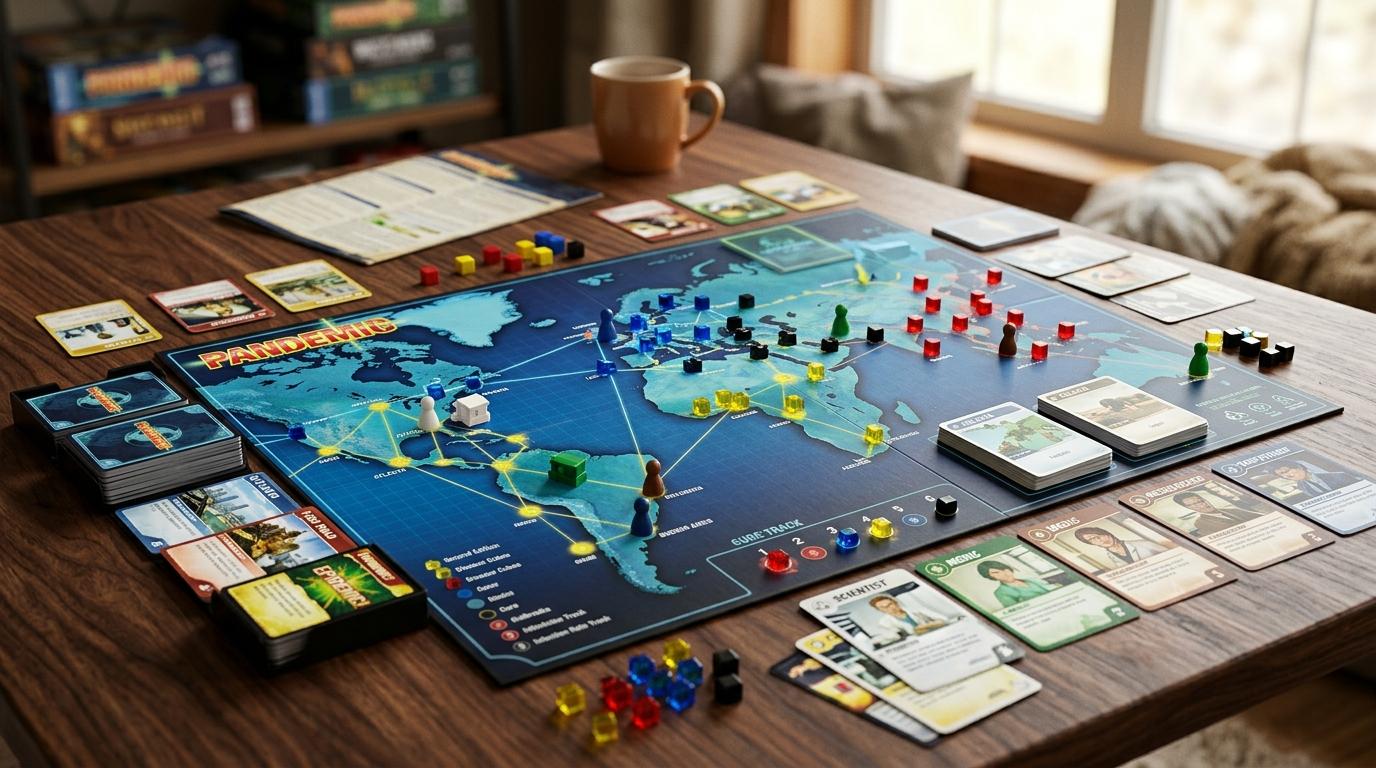
Spirit Island flips the co-op script, but is that punishing learning curve really worth leaving Pandemic behind?
For a decade, Matt Leacock's Pandemic was the answer to "what cooperative game should we start with?" R. Eric Reuss's Spirit Island, released by Greater than Games in 2017, is the game people point to when they want to argue that co-op has grown up. Instead of playing disease-fighting specialists racing to cure outbreaks, you are ancient spirits defending your island from colonizing invaders, growing your powers turn by turn until you can terrify the settlers off your shores. It is smarter, deeper, and thematically braver than almost anything in the genre. It is also a wall. So the question worth asking honestly is not whether Spirit Island is better than Pandemic. It is whether the steep climb to get there is worth what you give up.
Pandemic's genius is how fast it starts
Let us defend Pandemic before we bury it. Its enduring popularity is not an accident of being first. Pandemic teaches itself in about ten minutes because each player flexes exactly one special role, the map does one legible thing, and the tension comes from a deck you cannot predict. That unpredictability is the whole engine. You are always one bad card flip from disaster, and that dread is what makes a Pandemic table lean in.
For a family, a new group, or a weeknight where nobody wants a lecture, that accessibility is a genuine feature, not a limitation. A game you can pull out and teach cold is worth an enormous amount, and any argument that dismisses Pandemic as "the baby version" is missing why it still gets played.
Spirit Island trades comfort for control
Spirit Island inverts almost every one of those choices, and the inversion is the point. Where Pandemic thrives on chaos, Spirit Island runs on a predictable rhythm. The invaders forecast their moves: they explore, then build where they explored, then ravage where they built. You can see the destruction coming, which sounds like it would drain the tension. It does the opposite. Because so much is happening and you can never stop all of it, that predictable cadence is the only thing that lets you plan at all. The dread in Spirit Island is not "what will the deck do to me," it is "I can see exactly what is coming and I still might not have enough."
Then there are the spirits. Each is a genuinely different puzzle, with its own powers, growth pattern, and personality, and those powers deepen over the game rather than staying fixed. Lightning's Swift Strike plays nothing like River Surges in Sunlight. That variety is the game's soul and also its cruelty, because learning one spirit teaches you only a fraction of the next.
The learning curve is the whole debate
Here is where honesty matters. Spirit Island is hard to learn, and anyone who tells you otherwise is selling something. The first game is a slog of cross-referencing icons, misreading the invader board, and realizing on turn four that you set up your powers wrong. Two to three plays can pass before the machine clicks. For a lot of groups, that is simply too much homework for game night, and there is no shame in that verdict.
But the curve is not busywork, and that is the crucial distinction. Every ounce of complexity buys you meaningful decisions. The reason it takes three games to feel competent is that there are genuinely that many real choices, not that the rules are badly written. When it does click, Spirit Island delivers something Pandemic structurally cannot: the feeling of a losing position slowly, deliberately turned around by the group through actual planning rather than a lucky draw. That earned comeback is the emotional payoff the whole design is built to produce.
It also solves co-op's oldest problem better than most. Because each spirit is a distinct puzzle with private complexity, the dominant "quarterback" who solves everyone's turn for them has a much harder time. You physically cannot optimize four spirits you do not understand. That alone makes it a better cooperative experience for experienced groups than almost anything else on the shelf.
The verdict
These two games are not really competing for the same slot, and the smartest thing you can do is stop treating it as a choice between them. Pandemic is the game you hand to newcomers, to family, to any table that wants cooperative tension without a rulebook seminar. It earns its place forever, and swapping it out for Spirit Island would be a mistake.
Spirit Island is the reward you graduate into. If your group has felt the ceiling of lighter co-ops, if the quarterback keeps solving everyone's turns, if you want a game that respects how much strategy you can actually hold in your head, then yes, the punishing learning curve is worth it, emphatically. The payoff is one of the deepest cooperative experiences in the hobby, and the difficulty is the price of that depth, not a bug in it.
So do not leave Pandemic behind. Keep it for the nights it was made for, and climb the Spirit Island wall when your table is hungry for the harder, richer game on the other side. The curve is steep because the game underneath it is genuinely worth the climb.